Interactives
Steam
Cornwall doesn't have any coal but coal and the steam produced by burning coal are fundamental the mining story in the south west. In fact water is generally: as the sea which surrounds the County and which was for centuries was the main trade and travel route; as the troublesome water in the mines and in its vaporous state, as steam to drive pumping engines to remove that irritating flooding water.
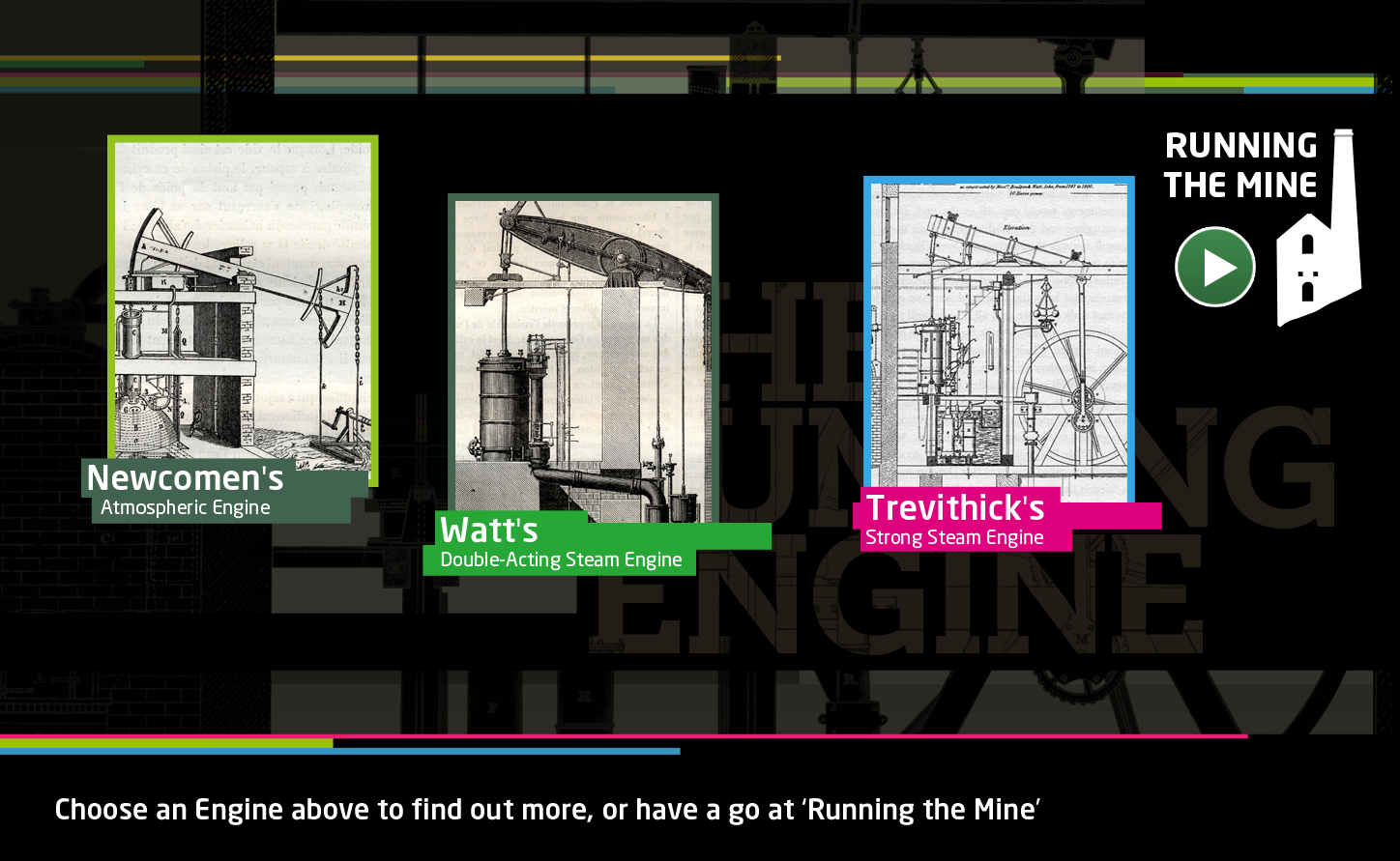
Newcomen, Watt and Trevithick
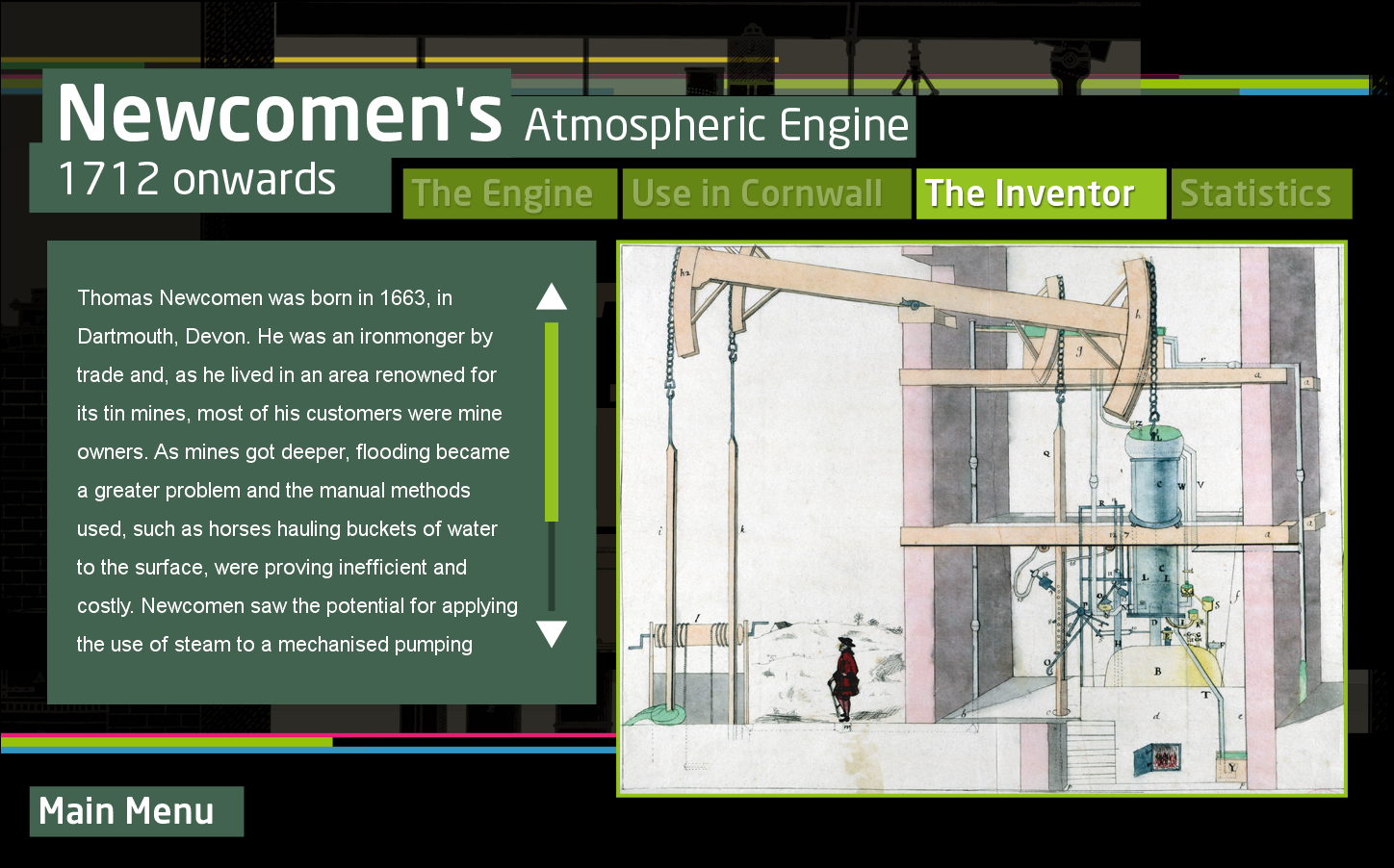
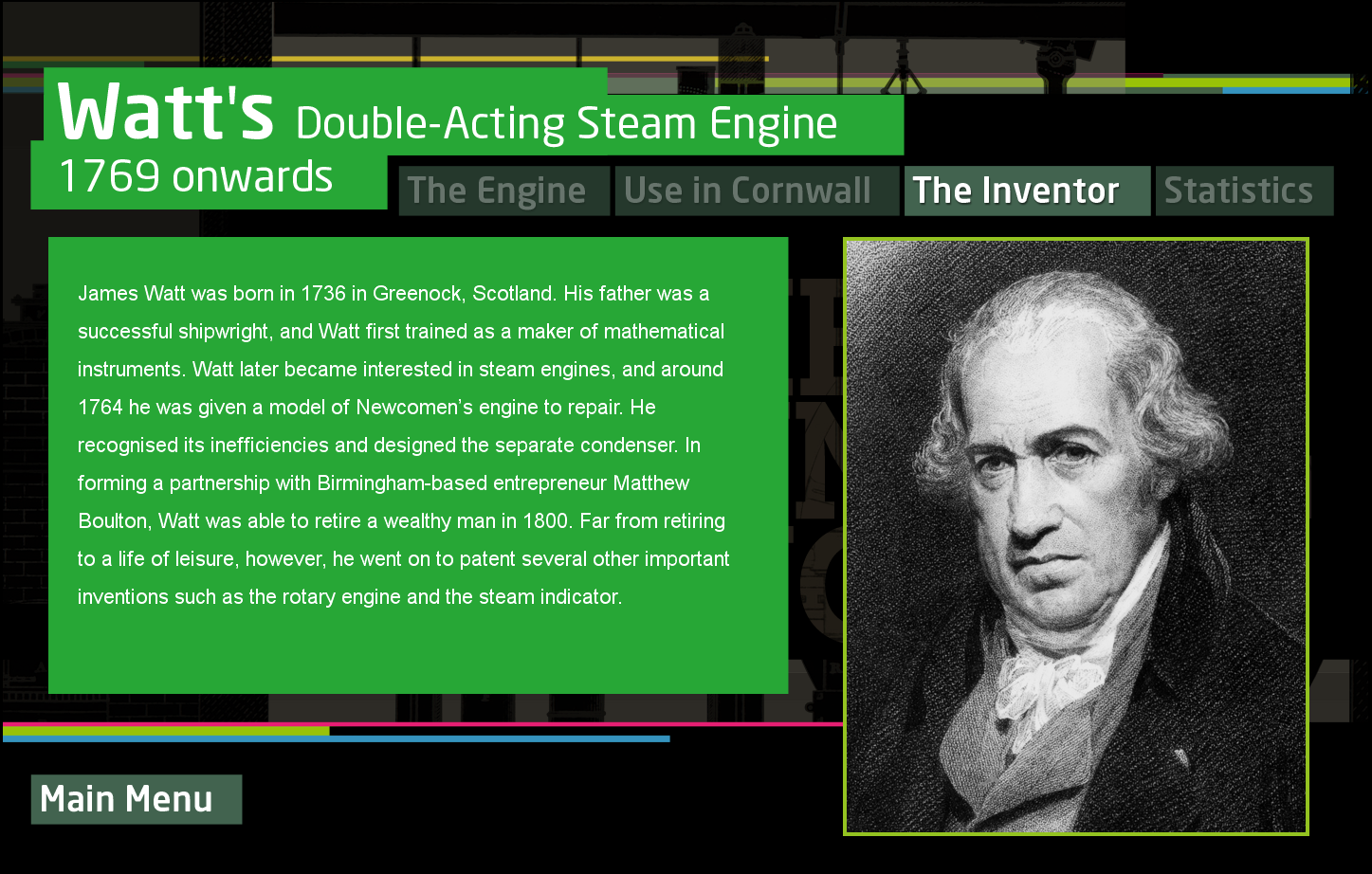
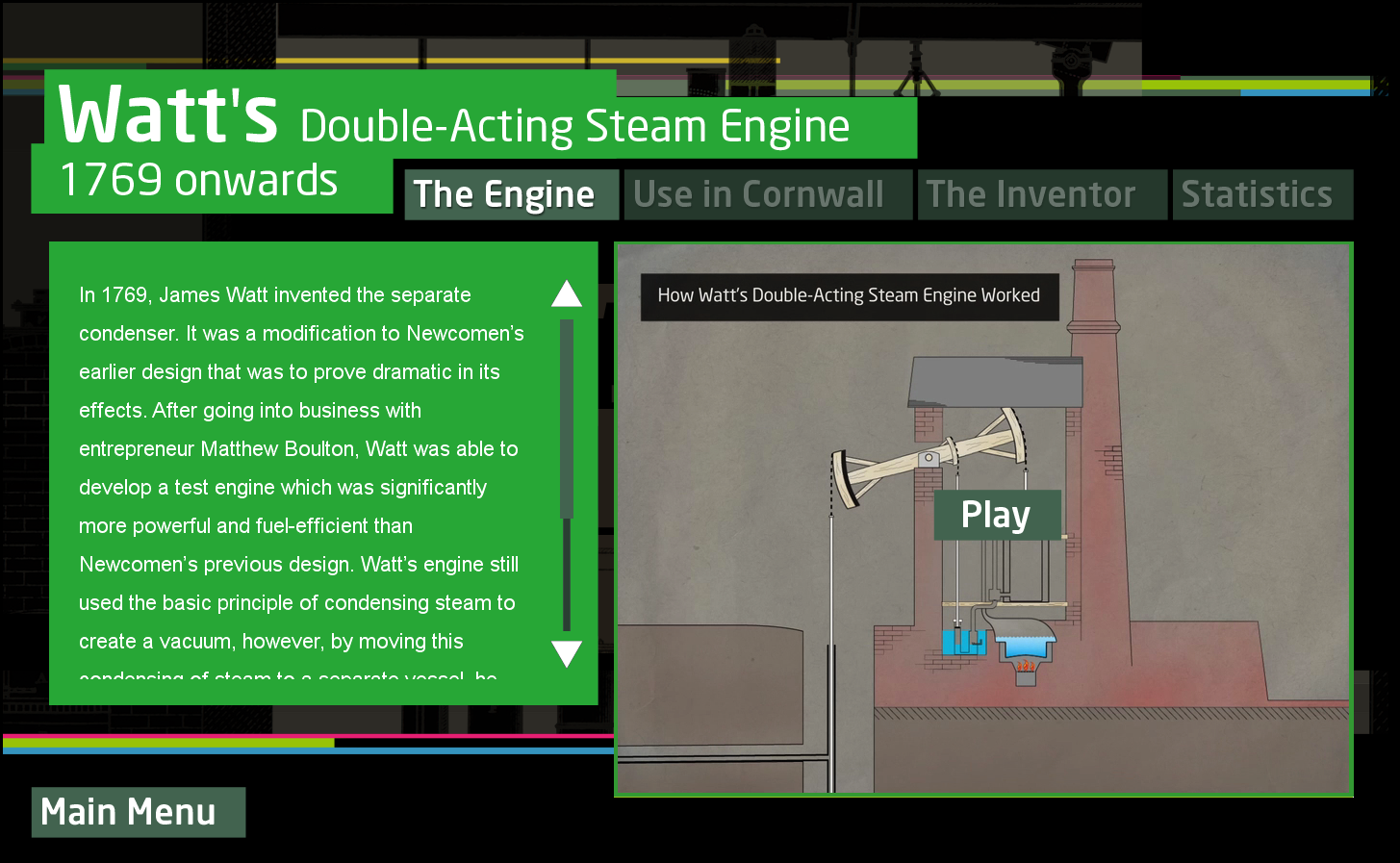
James Watt is sometimes described as the 'inventor of the steam engine'. He was not. Watt did however, in a series of experiments in the 1760s, 70s and 80s, was to create a machine which was the key invention of the Industrial Revolution - the rotary or as he called it the rotative engine. Rotary power made factories possible on the grand scale and liberated them from their countryside locations where they were dependent on wind and water power. Cornwall however is the beginning of this story. Watt's first development was for a pumping engine not one. He had improved the Newcomen atmospheric engine sufficiently for it to make more power, consume less coal and run faster than the Newcomen engine. Cornwall and its tin mines were the first real market for these machines and Watt stayed locally to the Heartlands site in Redruth in the earliest days of his developing commercial partnership with Matthew Boulton.
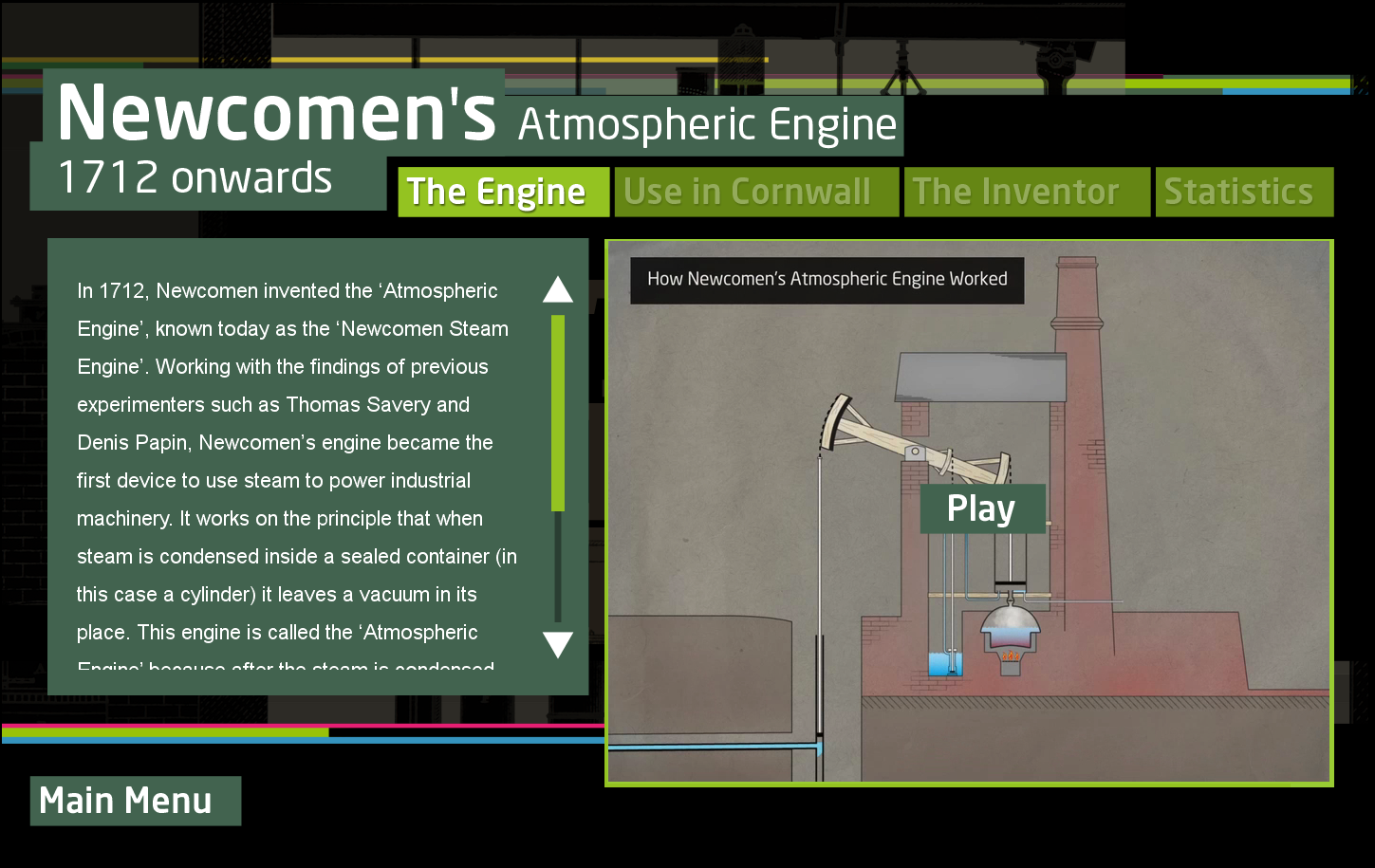
The engine at Heartlands is the Cornish adaptation of these early Watt machines and like them is is still an atmospheric engine, relying on the creation of a vacuum in a huge (80") cylinder to pump water from the mine. Made locally in Hayle.
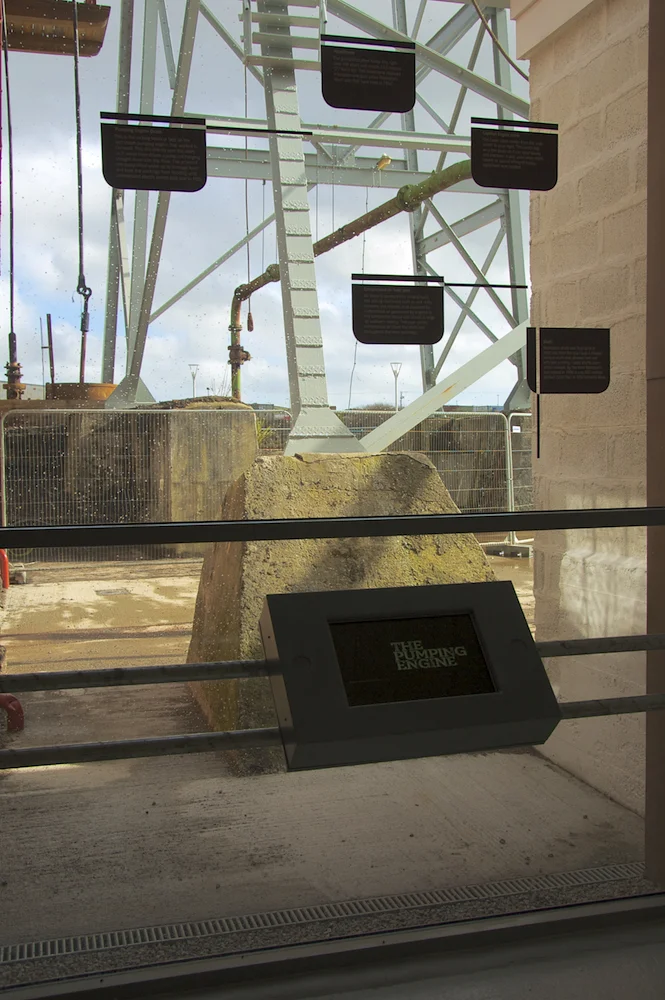
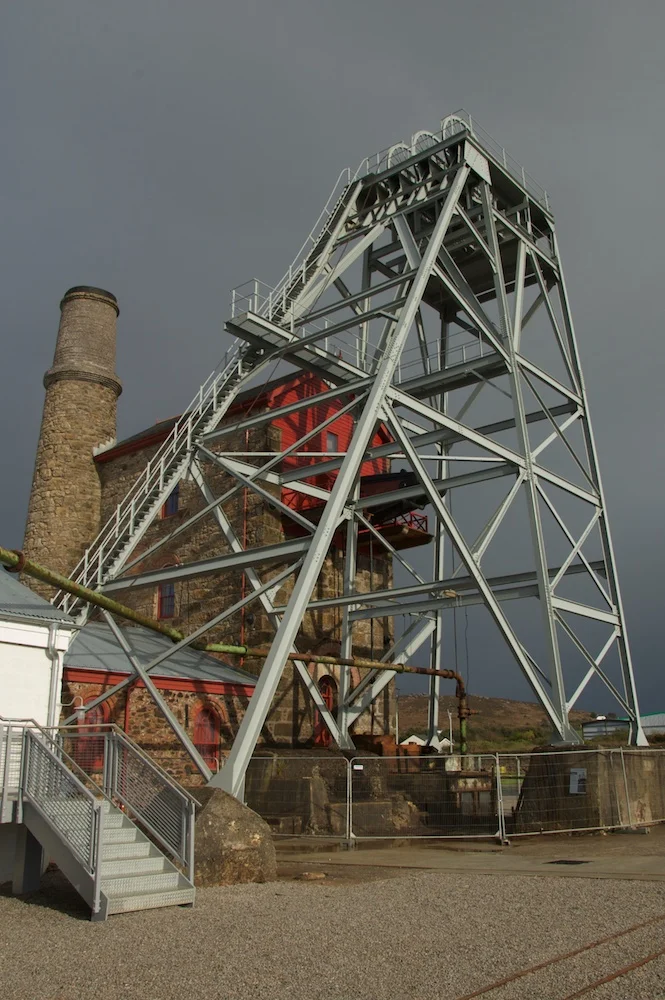
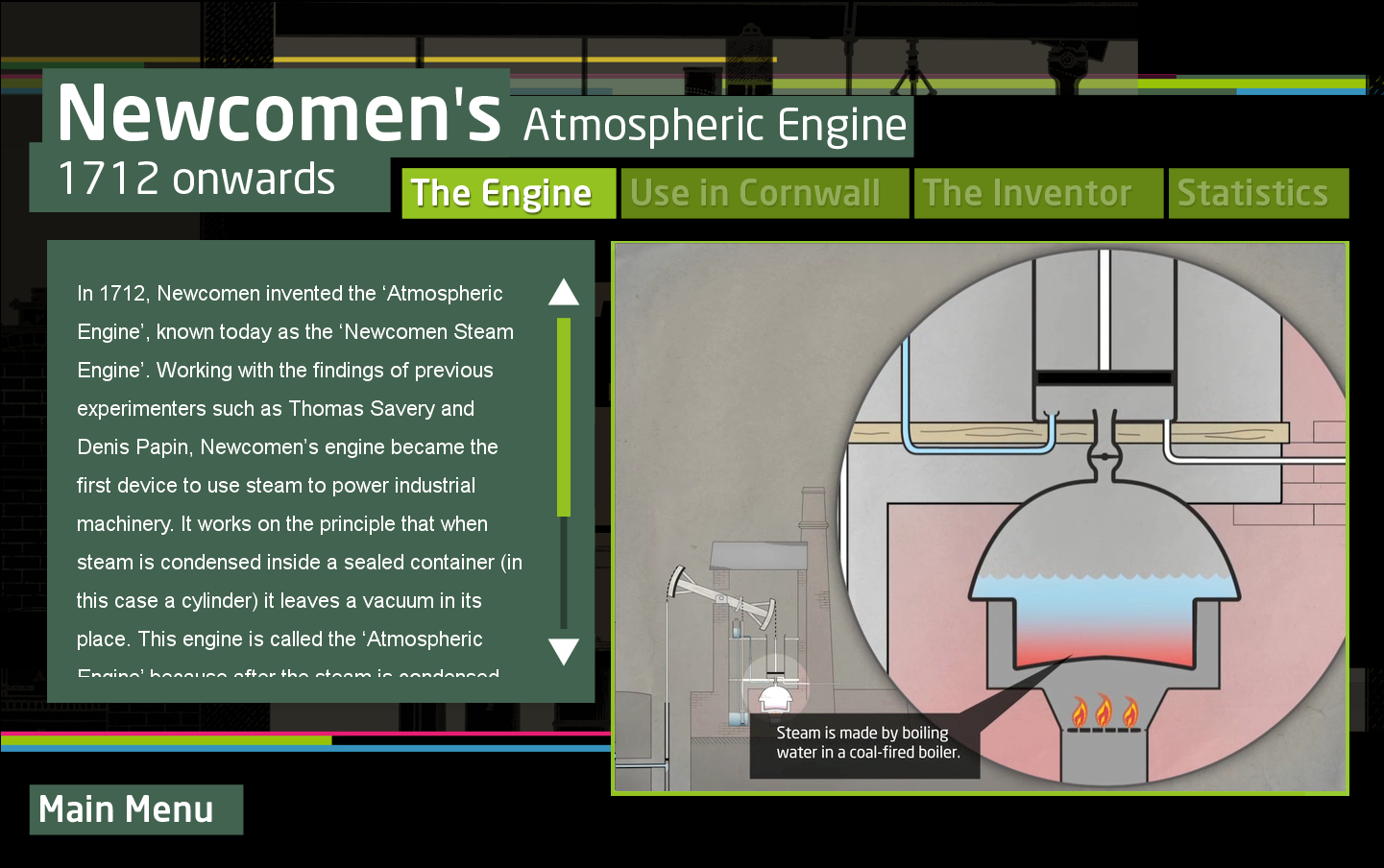
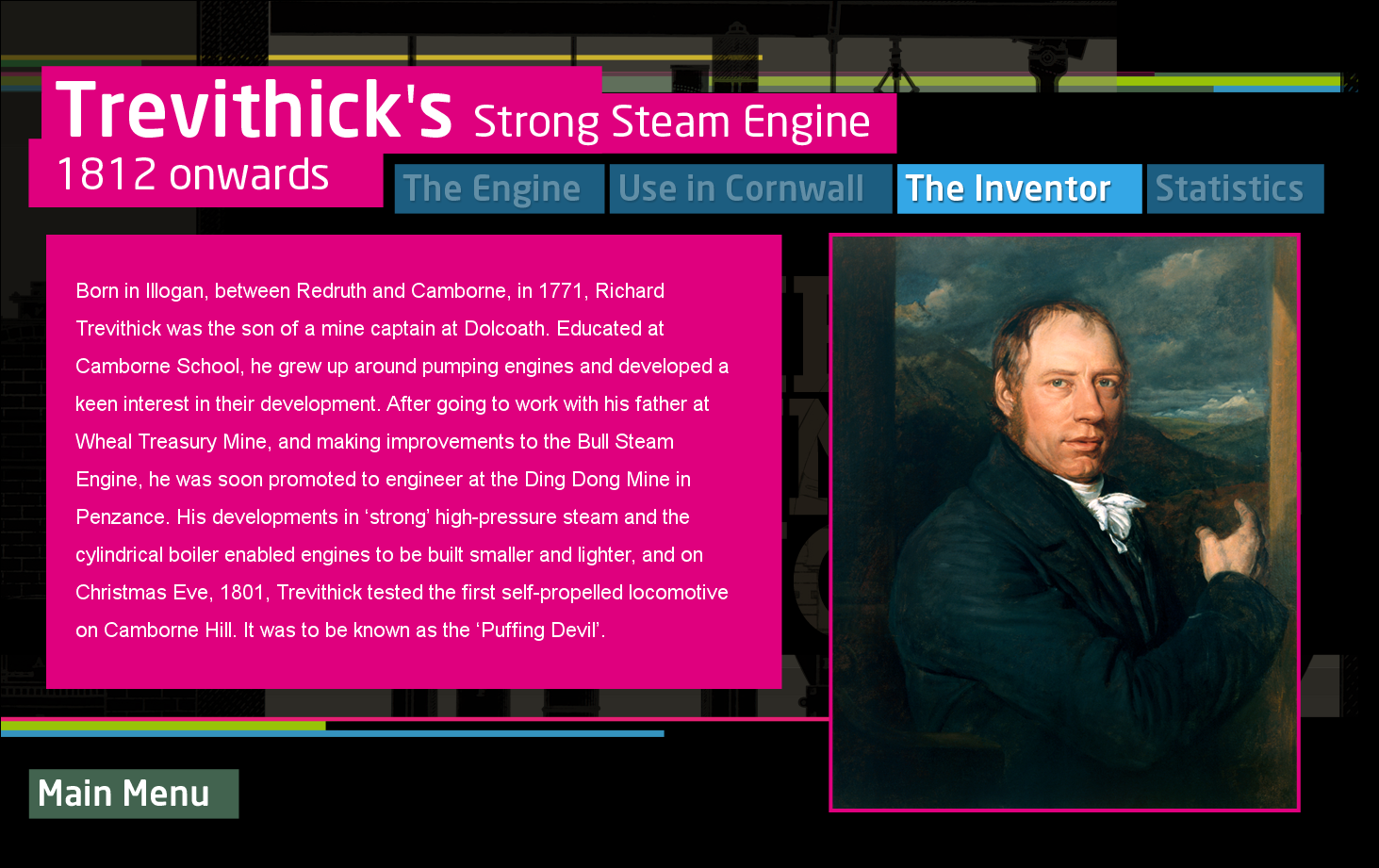
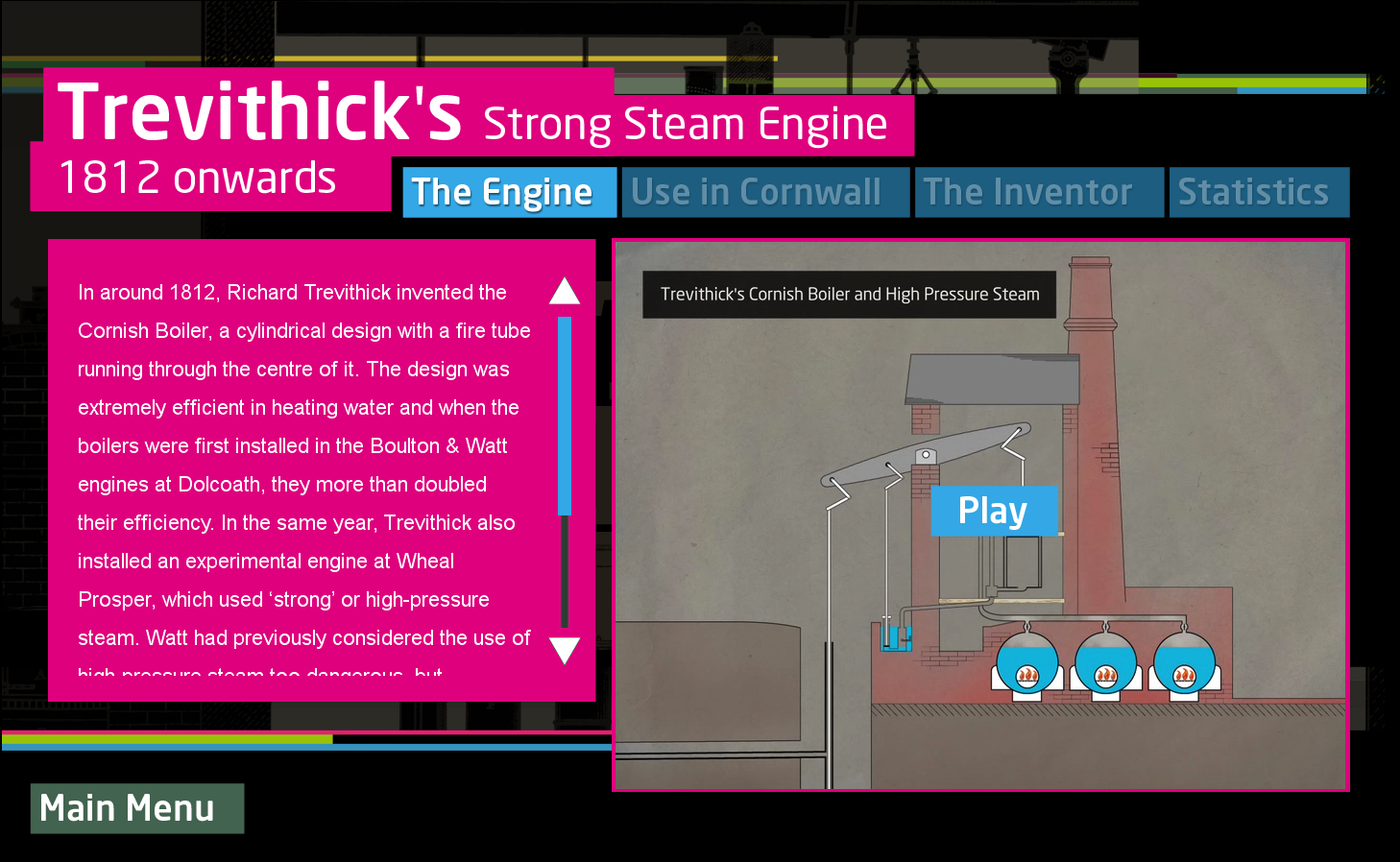
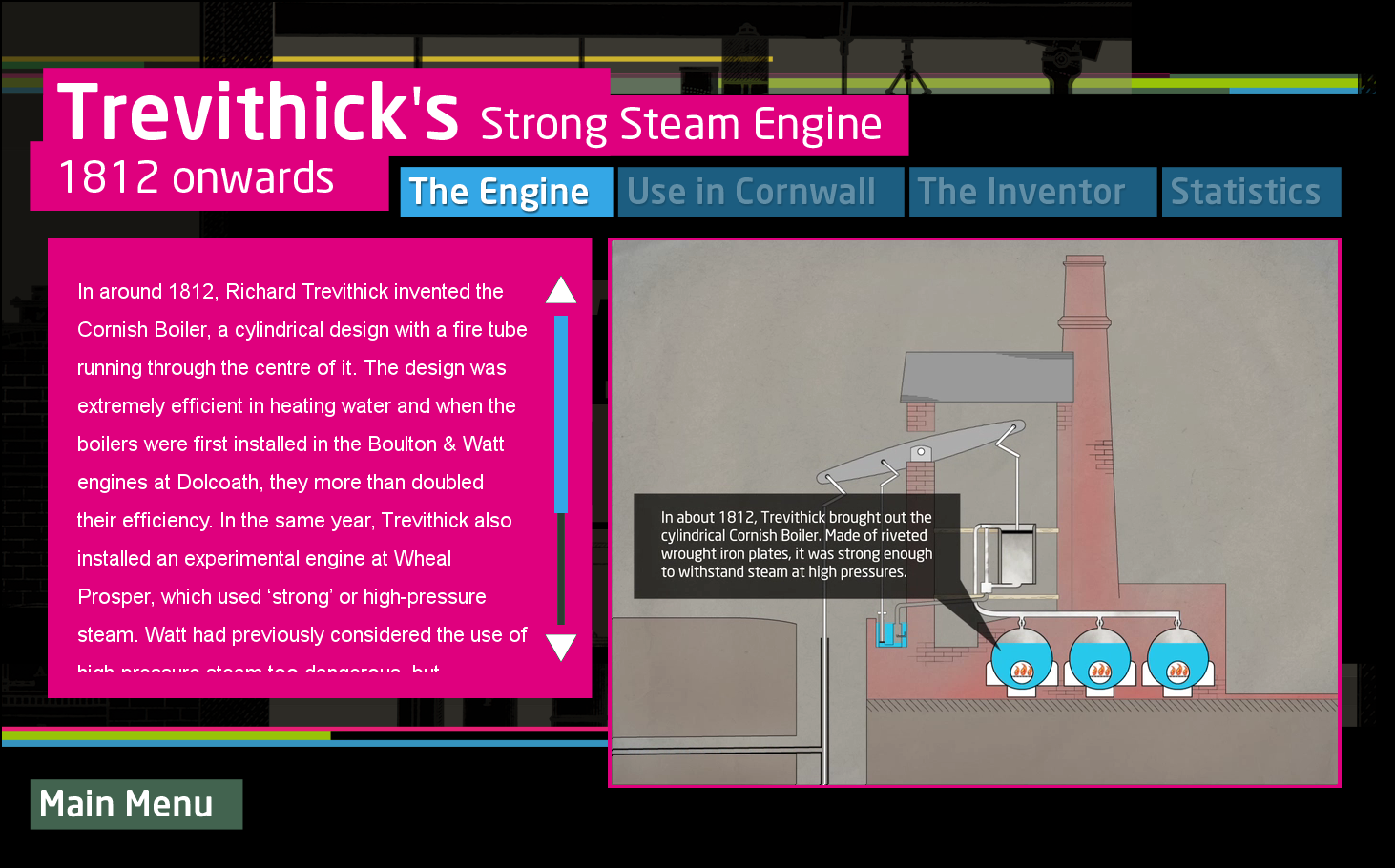
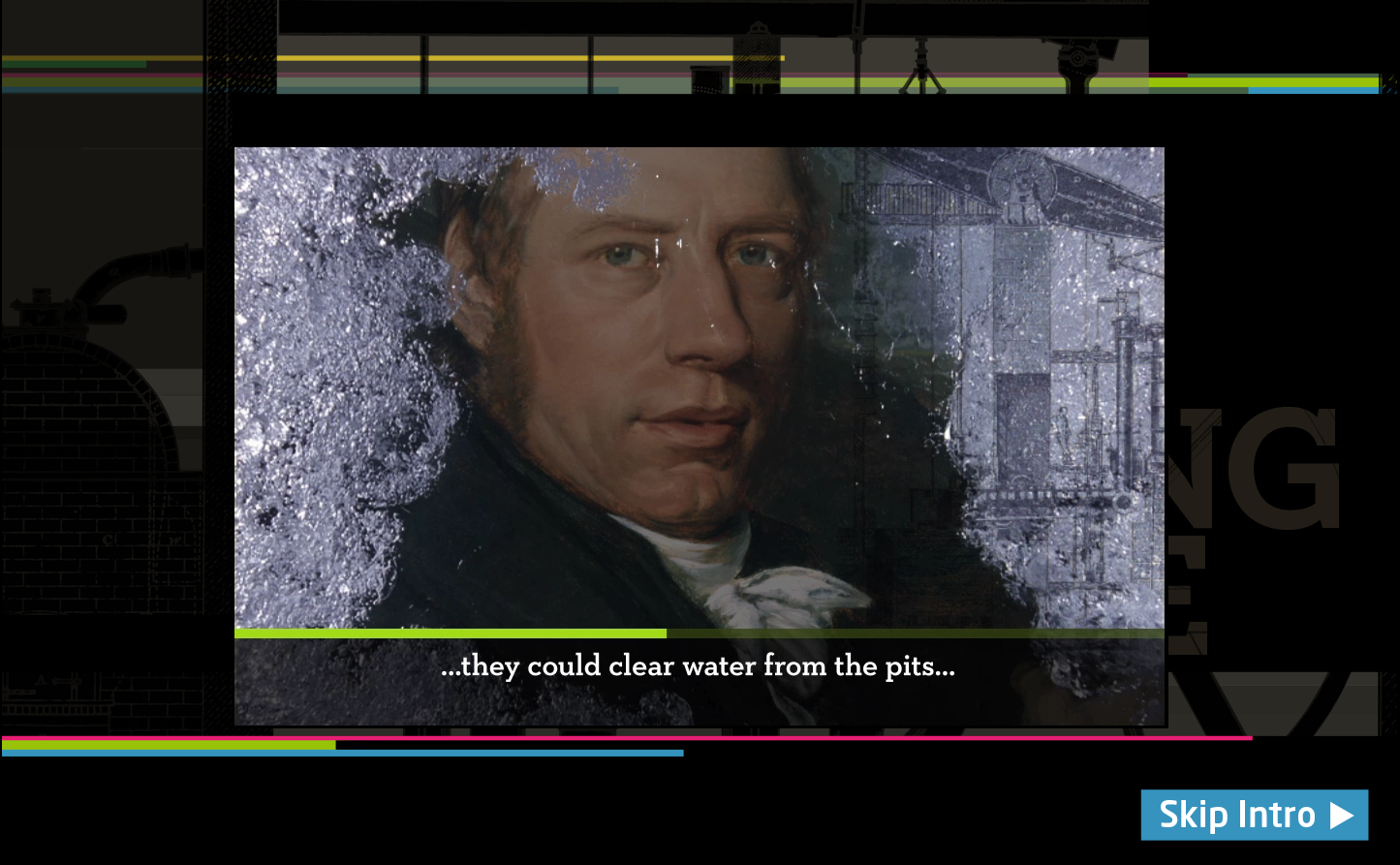
Though atmospheric engines were crucial to Cornwall's mining success, Richard Trevithick is equally, (and in some ways more) important in the story of steam. It was Trevithick who developed the high pressure device which quickly found its way into the locomotives and ships that powered Victorian Britain. The interactive screen that carries the media is shown here at left. The head-frame and pumping engine house at right.
Physics
Ice Water Steam
A better understanding of the properties of steam may be achieved by understanding the general molecular and atomic structure of matter, and applying this knowledge to ice, water and steam.
A molecule is the smallest amount of any element or compound substance still possessing all the chemical properties of that substance which can exist. Molecules themselves are made up of even smaller particles called atoms, which define the basic elements such as hydrogen and oxygen.
The specific combinations of these atomic elements provide compound substances. One such compound is represented by the chemical formula H2O, having molecules made up of two atoms of hydrogen and one atom of oxygen.
The reason water is so plentiful on the earth is because hydrogen and oxygen are amongst the most abundant elements in the universe. Carbon is another element of significant abundance, and is a key component in all organic matter.
Most mineral substances can exist in the three physical states (solid, liquid and vapour) which are referred to as phases. In the case of H2O, the terms ice, water and steam are used to denote the three phases respectively.
Ice
In ice, the molecules are locked together in an orderly lattice type structure and can only vibrate. In the solid phase, the movement of molecules in the lattice is a vibration about a mean bonded position where the molecules are less than one molecular diameter apart.
The continued addition of heat causes the vibration to increase to such an extent that some molecules will eventually break away from their neighbours, and the solid starts to melt to a liquid state. At atmospheric pressure, melting occurs at 0°C. Changes in pressure have very little effect on the melting temperature, and for most practical purposes, 0°C can be taken as the melting point. However, it has been shown that the melting point of ice falls by 0.0072°C for each additional atmosphere of pressure. for example, a pressure of 13.9 bar g would be needed to reduce the melting temperature by 0.1°C.
Heat that breaks the lattice bonds to produce the phase change while not increasing the temperature of the ice, is referred to as enthalpy of melting or heat of fusion. This phase change phenomenon is reversible when freezing occurs with the same amount of heat being released back to the surroundings.
For most substances, the density decreases as it changes from the solid to the liquid phase. However, H2O is an exception to this rule as its density increases upon melting, which is why ice floats on water.
Water
In the liquid phase, the molecules are free to move, but are still less than one molecular diameter apart due to mutual attraction, and collisions occur frequently. More heat increases molecular agitation and collision, raising the temperature of the liquid up to its boiling temperature.
Steam
As the temperature increases and the water approaches its boiling condition, some molecules attain enough kinetic energy to reach velocities that allow them to momentarily escape from the liquid into the space above the surface, before falling back into the liquid.
Further heating causes greater excitation and the number of molecules with enough energy to leave the liquid increases. As the water is heated to its boiling point, bubbles of steam form within it and rise to break through the surface.
Considering the molecular arrangement of liquids and vapours, it is logical that the density of steam is much less than that of water, because the steam molecules are further apart from one another. The space immediately above the water surface thus becomes filled with less dense steam molecules.
When the number of molecules leaving the liquid surface is more than those re-entering, the water freely evaporates. At this point it has reached boiling point or its saturation temperature, as it is saturated with heat energy.