How We Develop and Run Projects
See also Models and Methods for more on the processes which lie behind our approach.
We regularly set up multi-disciplinary teams for exhibition, museum and development projects. In many cases SFL takes the lead consultant / directorship role, pulling together and managing the team on behalf of our clients. In other cases we bring our specific skills and expertise to a team led by others.
As Lead Consultant we act as an extension of the client’s own team and therefore have the capacity to draw from a large and varied skill base. The Lead Consultant becomes the guardian of the project dealing with risk, minimising discontinuity across the different disciplines.
As a Lead Consultant, Stephen Feber Limited assists clients in accelerating the early procurement and co-ordination processes; supplementing in-house resource deficiencies; initiating complex projects through an holistic approach and generating valuable early momentum; and, vitally, formulating the development vision and strategy underpinned by the client’s own objectives.
Project management is at the heart of SFL’s successful delivery approach to cultural and heritage attractions. Our methodology is based on a system pioneered in the UK National Museums and is the summary of thirty years of practical application across the world.
Projects have a beginning, middle, and an end. Unfortunately, this isn’t always understood by those organisations undertaking them. Stephen Feber Limited uses an adapted version of Prince2 project management processes for successfully delivering their client’s projects. Prince2 is a set of standard processes created by the Office of Government Commerce (OGC) to establish and support a high standard for managing projects for the UK government.
Projects
- Are discrete packages of work that are a part of any organisation’s existence
- Bring about creation, change, and renewal to any organisation
- Have defined resources
- Have a defined timetables with a clear beginning, middle and end
- Have unknown elements and therefore create risk to any organisation that undertakes them
- Have measurable outcomes
Project Management
The term ‘Project Management’ refers to the collective processes that delivers planning, monitoring and control of all aspects of a project and the means of motivating of all those involved in it to achieve the project objectives on time and to the specified cost, quality and performance.
The Project Manager is the person given the authority and responsibility to manage the project on a day-to-day basis to deliver the required products within the constraints agreed with the Project Board.
The Project Board is responsible for the overall direction and management of a project and has responsibility and authority for the project.
Once a project idea has been “green-lighted” what follows are a series of steps that take it through the standard OGC gateway / Prince2 stages. During the first stage - Initiating a Project - a project ‘contract’ is drawn up in the form of a Project Initiation Document (PID) between the Project Board and the Project Manager, so that there is common understanding of:
- The reasons for doing the project
- What key products the project will deliver
- How and when these will be delivered and at what cost
- The scope of what is to be done
- Any constraints which apply to the product to be delivered
- Any constraints which apply to the project
- Who is to be involved in the project decision making
- How the quality required will be achieved
- What risks are faced
- How the project is to be controlled
- Who needs project progress information, how and when
From this point on the project moves through each stage and at every milestone or ‘gateway’ it is evaluated to see if it is on target for delivery of its specific aims. This continues throughout the lifespan of the project until it is complete.
Project Management Structures and Roles
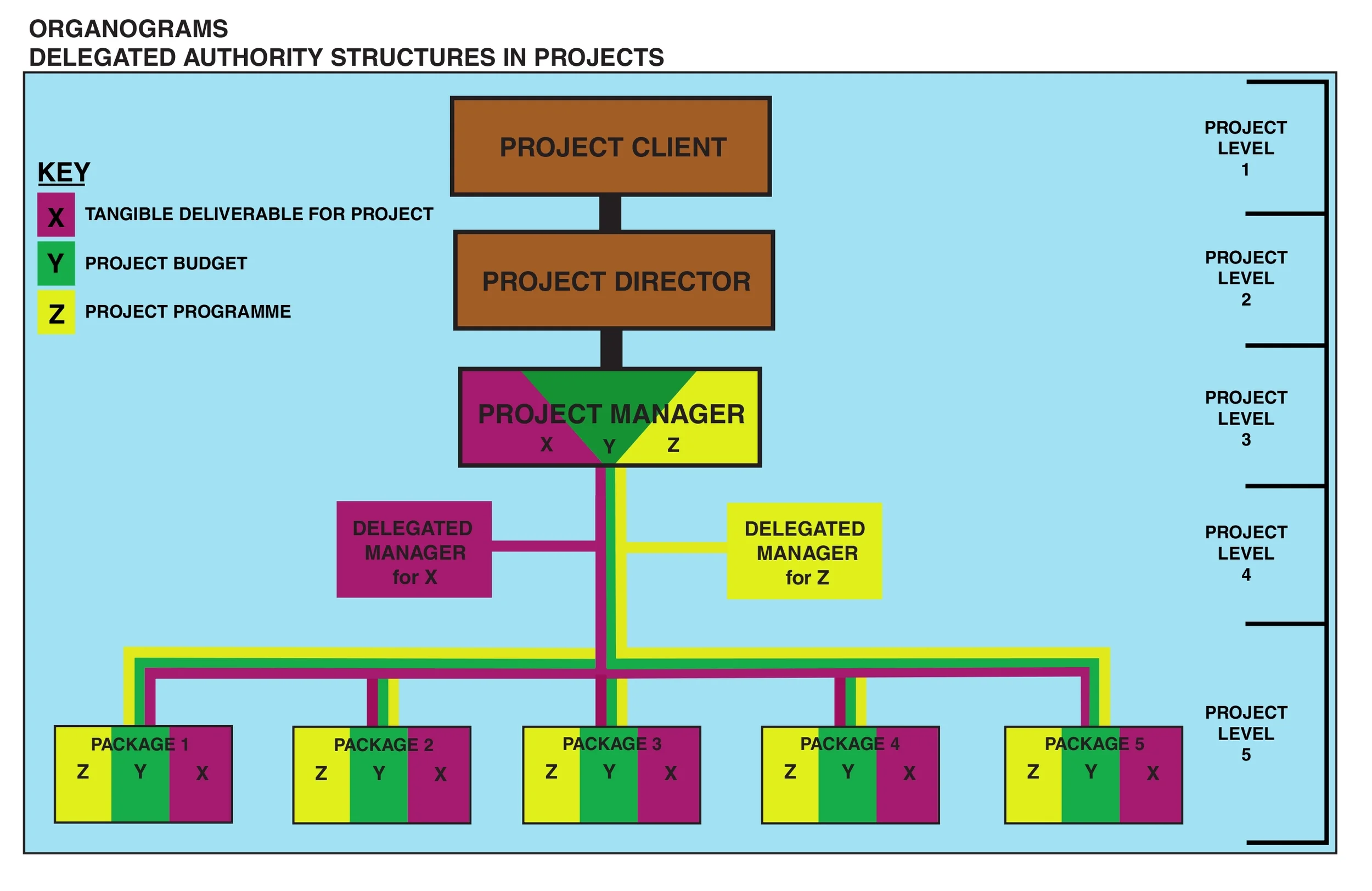
The chart above explains in diagrammatic form the organisation that SFL's projects use. The principle on which this chart is based is called ‘delegated authority’. Large projects are complex and often risky ventures for an organisation to undertake. Millions of pounds can be at risk if there are not clear lines of authority and clear definitions of responsibility for each of its management team. The term ‘delegated authority’ refers to the allocation of those responsibilities and that authority to individuals at each level of the project. The Project Client is defined as the final owner who will receive the operating project and its outcomes. The Project Board oversees the project from a strategic level ensuring that it is meeting its business case objectives. The Project Manager is the ‘hub’ of the project and is responsible to deliver the three basic components of the project:
- Project content (X)
- Project budget (Y)
- Project programme (Z)
The Project Manager can also delegate aspects of these responsibilities to managers on the next level down. Package Managers are responsible to the Project Manager (or their delegated manager for any of the three basic components) for delivering their package.