Diana: a Princess Remembered
In October 2006 we were contacted by Jo Thwaites from the Conservation and Learning Department at Historic Royal Palaces to see if we could help them with their forthcoming bid to the Heritage Lottery Fund. Since the arrival of Michael Day as Chief Executive, the mission of HRP had been realigned to feature story telling as a central theme. Could we help HRP with its story making at Kensington Palace and thus help create a better HLF application?
Story Workshops
LVT in action - provoking deep thought
LVT in Action - thinking - a connected but not yet gathered cluster of ideas are on the board.
The early stages
First stories from the Senior Management Team
The outcome was four days of workshops which we ran with a facilitator, Dan Varney. We used a technique for capturing the work of the HRP teams called Logo Visual Thinking (LVT) and we based the structure of both sessions on the work of Robert McKee. McKee much known in heritage circles, at the time, but he’s well known in Hollywood because he’s written the definitive book on scriptwriting or how to tell a great story. Although Hollywood and Kensington Palace might seem strange bedfellows, they got on very well together. McKee is very clear that character is central to story. Any tale, be it movie, book, or play, is made out of conflict, specifically the inner and outer conflicts between the protagonist their situation. When we consume stories we journey through this ‘arc of character’, following the cycles of antagonism and resolution. There also has to be an ‘inciting incident’ to fire the story off and we have to care about what’s happening; if there’s something at stake the unfolding narrative grabs our attention. There’s a lot of evidence that what we’re emotionally engaged with we remember better. Better memories equal more word of mouth comment: a story re-told helps with marketing. Perfect for the exhibition format.
LVT story shapes
The idea of the journey of the central figure, fitted many of the Royals well but the challenge was to choose which pivot to hang the stories on. There were plenty of inciting (or what some of the curators translated as ‘insightful’) incidents to choose from, but we needed an antidote to a dull parade of the facts, history as one damned King after another. Dan and I developed a story telling kit for the teams to work with which allowed them to play with plot, character, incident, space and objects in a flexible way to create exhibition storyboards. This was where Hollywood met Kensington Palace.
Find out more about LVT here.
Diana
Image courtesy of Historic Royal Palaces
Image courtesy of Historic Royal Palaces
We were then invited by David Souden, Head of Access and Learning, to help with an exhibition to mark the tenth anniversary of the death of Diana Princess of Wales. Diana. Here was a subject everyone knew and about which many have strong opinions, positive and negative. It’s a story that abounds with what are called ‘sensitivities’. A sensitivity is like the Holy Ghost, pervasive, powerful but rarely seen and never expressed, except when offended. So, the Palace, the Prince of Wales, the two Princes, the HRP trustees, HRP staff, all required very careful attention.
There were other challenges. This was to be a subject driven exhibition, made to mark the anniversary of her death and incorporating the Mario Testino photographs, the last photo shoot of the Princess. The only traditional objects in a museum sense were some of her dresses. The audience at Kensington Palace was very Diana driven but 50% of it is from overseas and the very tight budget would not allow multi lingual translation. Lastly, the fabric of the building was and is jealously guarded by HRP and English Heritage.
Treatment
The real question though was how to make something that wasn’t either memorialising or mawkish, or diluted by second hand offerings from social commentators like Peter Yorke or Roy Strong, often trotted out to pad documentaries on the television. The original brief was titled Reflections and we wanted to move this on to offer direct testimony - first hand witnessing of her life. I had experimented with large scale digital projection at Magna where the original Face of Steel entry experience had been developed by Event and Centrescreen to my brief. This had worked well and a ‘time based media’ approach also seemed right for Diana. This idea was developed in conversation with David Souden who reminded me about the work of video artist Bill Viola.
Space for the Story I
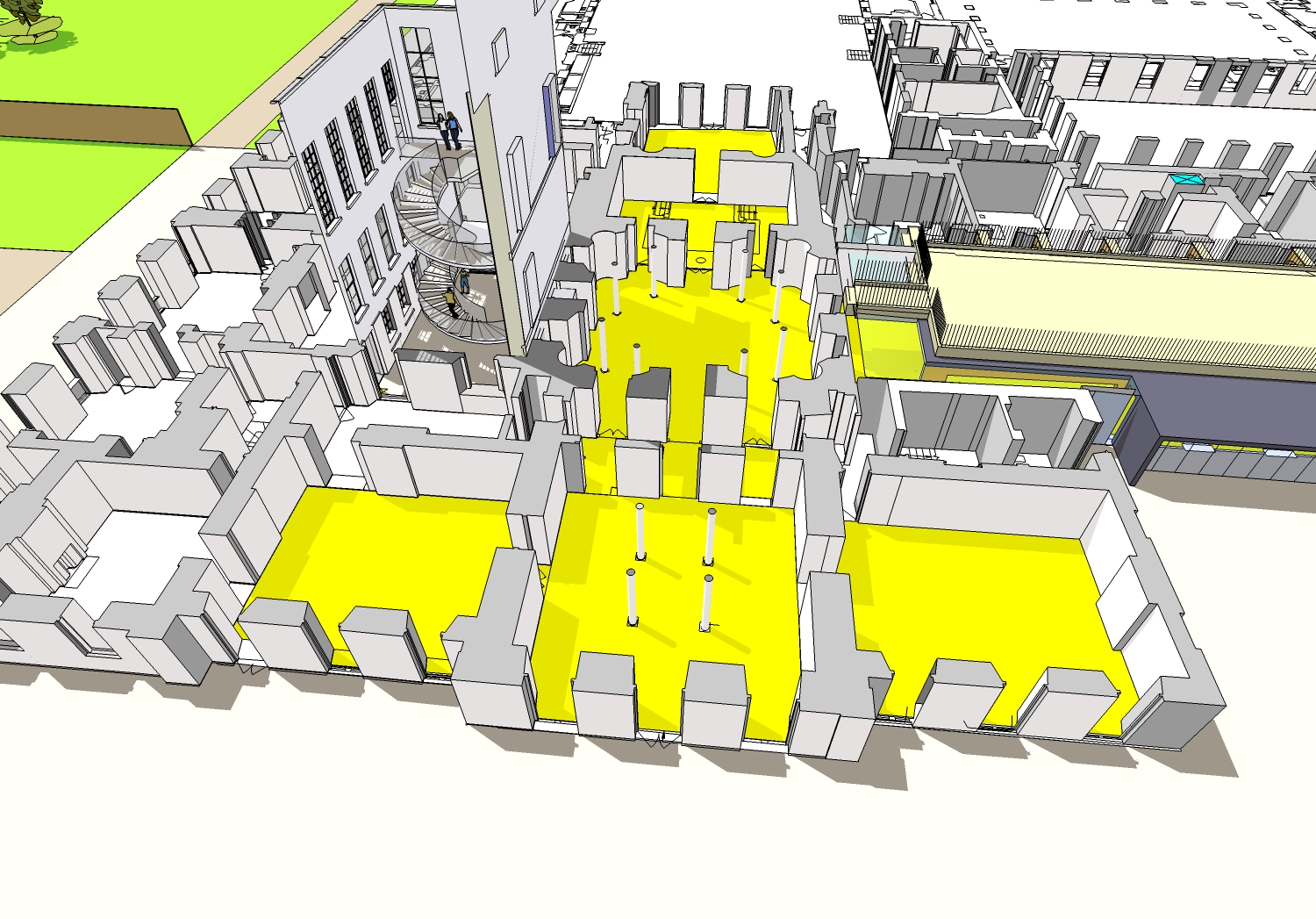
Before the current refurbishment of Kensington Palace, the Diana exhibition acted as a trail blazer - finding new ways to bring to life a fairly dull interior. Our CAD model shows the area we used on the ground floor for the exhibition:
Space for the Story II
A key lesson from McKee is to leave space for the audience to create their own meanings. There was in any case no point in taking a line on Diana because HRP by definition could not take a stance – was she betrayer or betrayed, saint or sinner, manipulative or manipulated? Probably yes to all of the above. But so what? What the exhibition had to do was offer the materials for individuals to make their own stories. And it had to have a propellant, a narrative form that helped embed the hook of curiosity.
A 'fishbone' diagram of story flow across the three types. Esc. to return
In one of McKee's formulations stories are divided into three basic types - Detective story, Thriller and Dramatic Irony. The detective always knows more than the audience, in the thriller the protagonist and audience are moving through the story together but in Dramatic Irony the audience knows more than the protagonists. Diana's was a story of dramatic irony: few stories were as rich in irony as hers.
We did a number of interviews involving with those who had been close to Diana or who had witnessed events involving her at first hand. But witnessing, although very powerful has less impact than contemporary image, especially the moving image.
HRP has excellent connections and we were able to source footage from the BBC covering the period from Diana first breaking cover as a subject for the media, through the engagement to the extraordinary scenes surrounding her wedding. The sequences about the engagement and wedding were however the most interesting and most difficult to do. The original concept was to have a room with wall sized digital projection on each wall using digital projectors. We would see her engagement and wedding, the watching crowds, the Royal Family and the media, the Fourth Estate. Ironically we had to cut the media out on cost grounds. If there is a hallmark of Diana’s life it’s the theme of watching – being looked at, consumed, re-processed. Her image, even today, sells newspapers and magazines, she was the most photographed and looked at woman of our age and her struggle with how she appeared, with what could and could not be seen and reproduced, is a key line throughout her journey as a Princess.
The Installation
To make the video installation we largely worked with the BBC archive footage of the wedding. My first principle was to find footage by the four themes for the space. This was assembled into an edit sequence for the editor and director we used, the creative and collaborative David Bickerstaffe, from Newangle. I really wanted to run long sequences of this material, at least 30 minutes per wall but in the end we cut the sequences down to small seven minute segments. There was always a tension between the old idea of a story to be told and my desire to create an immersive space to be absorbed in. Despite this loss from my viewpoint, a central and powerful feature remained, that the walls comment on each other without the need for written or voice over commentary. In the main video space, Diana, chased by the press photographers, is finally captured, willingly, by the marriage process. She moves from a blushing awkward young woman to an extravagantly dressed bride and then to wife standing on the balcony at Buckingham Palace, watching the crowd watching her. From watched to watcher in a day.
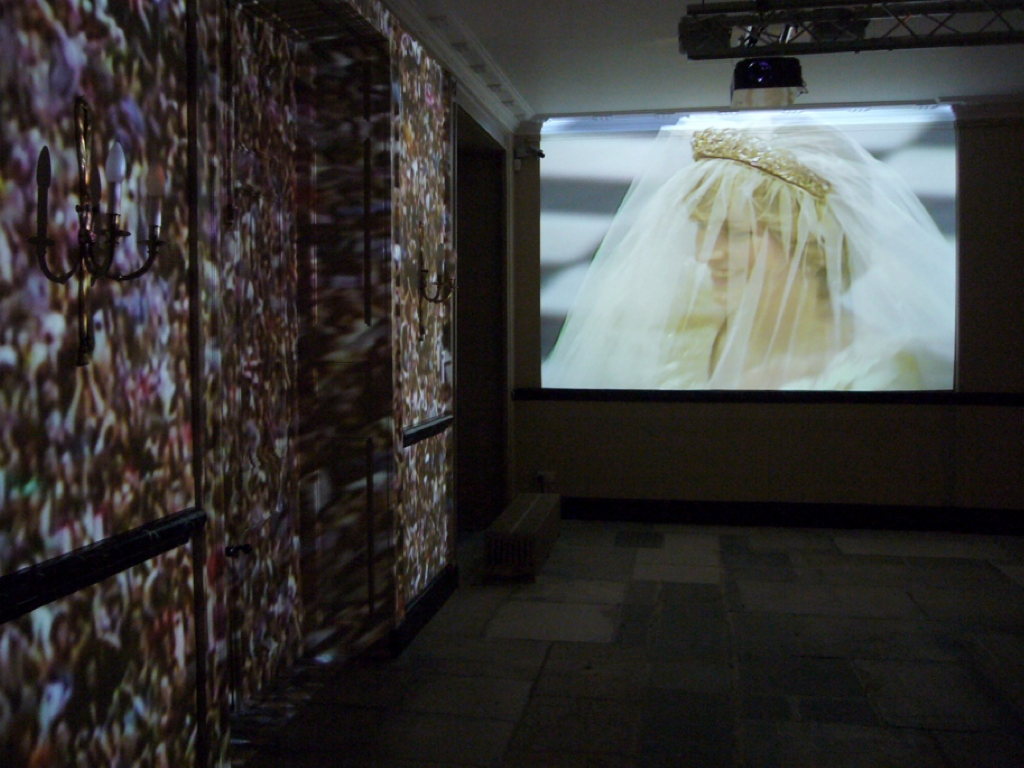
The Wedding and the Crowd
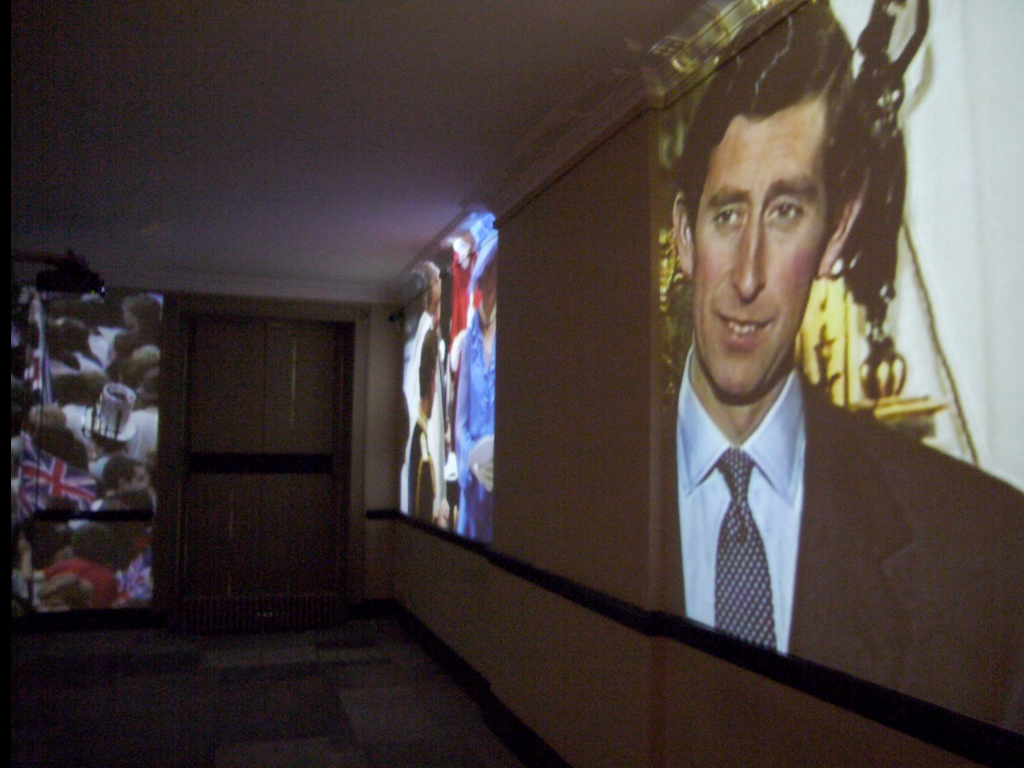
The Engagement
The viewer stands in the middle of these multiple views, which are selected by theme and shifted in time. He or she can experience them as they wish, making their own sequencing and assembly decisions. Lastly, whilst there are few traditional objects in the exhibition, in fact it is full of artefacts, albeit digital ones. I was struck by how powerful the spaces became when we shifted time sequences, assembled new narratives and lingered on some clips, showing them more slowly than ‘real time’. The multiple nature of the subject and the life is the most striking thing. The BBC edit of the day’s footage is no more real than our re-compilation.
As George Lucas has it – we tell stories to get at a truth behind the facts.